

Turn production into the experience.
Many bakery formats are being redesigned to look more like cafés. Better seating, stronger coffee, warmer materials, digital ordering and more comfortable dwelling can all improve the customer experience.
But if the next bakery is designed primarily as another café, it risks hiding the very thing that makes the category distinctive.
A bakery produces. Dough changes through time. Fermentation has a rhythm. Ovens create heat and smell. Ingredients have origin and texture. Products appear at particular moments of the day. Craft is visible in repetition, judgement and timing. These are not backstage details. They are potential reasons to visit, watch, wait, buy and return.
The opportunity is therefore not simply to redesign the store. It is to rebuild the proposition around what only a bakery can credibly own.
Production as Experience
In many formats, production is treated as an operational necessity to be concealed behind the customer environment. The more interesting model asks which parts of production should become part of that environment.
Visible proofing, shaping, finishing or baking can make freshness observable rather than claimed. Ingredient displays can connect products to provenance. A batch leaving the oven can create a moment of anticipation. The smell and sound of production can give the space a rhythm that no decorative concept can reproduce.
This does not mean turning every kitchen into theatre. Hygiene, safety, workflow and productivity remain non-negotiable. The point is to identify the parts of the process that create customer value and design the operational system so they can be experienced without compromising performance.
When production becomes visible with purpose, the product and the place begin to reinforce each other.
The strongest bakery format does not hide production behind the experience. It turns production into the experience.
Formats That Work
The evidence is already visible in the category. At Keit Kreuzberg in Berlin, an antique millstone has been cut into three sections and rebuilt as the bakery counter, turning an object from the history of bread-making into part of the contemporary customer experience. At Sofi, also in Berlin, the oven sits at the centre of the space and production is treated as choreography rather than something concealed behind the scenes. At Krume Bäcker in Panama City, locally sourced compacted earth gives the interior a material identity rooted in place and craft. And at Liberté in Paris, just 25 square metres are enough to create intimacy between customer and baker through a narrow opening onto the working bakery.
The approaches are different, but the principle is the same: the strongest bakery concepts do not simply create a setting in which to sell bread. They turn what is distinctive about the bakery itself into something the customer can see, feel and remember.
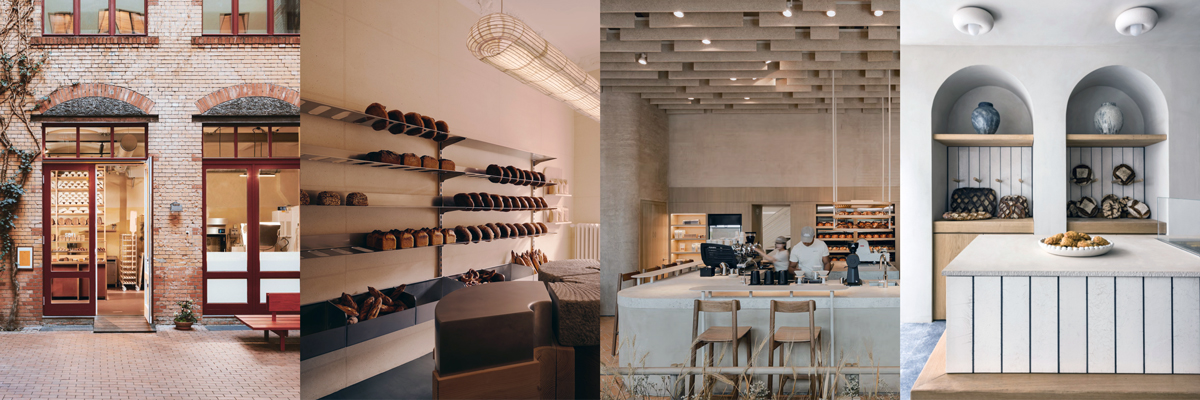
Bakery interiors that turn the category itself into experience. Clockwise from top left: Sofi, Berlin; Keit Kreuzberg, Berlin; Liberté, Paris; Krume Bäcker, Panama City.
Credits: Sofi, design by Mathias Mentze & Alexander Vedel Ottenstein with Dreimeta; Keit Kreuzberg, Studio Michael Burman; Liberté, Emmanuelle Simon; Krume Bäcker, Mallol.
Designing the Day
A bakery has a natural operating clock. Morning bread, breakfast pastry, lunch, afternoon treats, celebration products and end-of-day surplus do not have to behave as one continuous display.
Timed product drops can create reasons to return at different hours. A particular loaf at 11:00, warm pastries after school or a limited afternoon bake can turn production scheduling into customer programming.
The same principle can extend beyond transactions. Classes, tastings, collaborations with local producers and small community moments can use the craft itself as content. Subscription and pre-order systems can make routine purchasing easier while giving production teams better visibility of demand.
The format becomes more than a room containing products. It becomes a daily sequence of reasons to engage.
Ingredients as Story
Bakery products already contain material that can communicate provenance, seasonality and craft: flour, grains, butter, fruit, chocolate, spices, seeds and local specialities.
The question is whether the format makes any of that legible.
Ingredient storytelling should not become decoration or a wall of claims. It can be embedded in product naming, displays, packaging, tasting, staff knowledge and the physical relationship between ingredients, production and finished goods.
For operators with multiple locations, this can also create a stronger balance between a consistent brand system and local relevance. The operating model remains recognisable, while selected ingredients, products or collaborations respond to place.
A Second Life
Bakery is also a category in which freshness creates a difficult commercial tension: abundance is attractive, but unsold product has a cost.
The answer is not to romanticise waste. It is to design better information, assortment, ordering and production decisions, then identify credible uses for surplus that remains.
Yesterday’s bread can, where food-safety and product requirements allow, become an ingredient in new products, crumbs, rusks, puddings or other secondary uses. Surplus can also be redirected through appropriate donation or recovery channels.
Circularity is strongest when it is part of the operating system rather than a sustainability message added afterwards. The commercial question is how to reduce avoidable surplus first, then retain as much value as possible in what remains.
Scaling the System
Roll-out often encourages repetition. Once a successful pilot exists, the temptation is to reproduce its materials, fixtures and visual language across the network. Those elements matter, but they are not the most valuable part to scale.
A stronger bakery format defines the system behind the experience: which production moments are visible, how the day is programmed, how customers move between purchase and dwell, how ingredients are communicated, how pre-order and pick-up work, how local variation is introduced, and how surplus is managed. That system can then adapt to different footprints, locations and customer patterns without losing the proposition.
The result is not twenty identical interiors. It is twenty locations delivering the same strategic promise through an operating model flexible enough to fit each site.
Rebuilding the Proposition
The next generation of bakery will not be differentiated by adding more café furniture around a display counter. Its advantage is already there: production, freshness, craft, ingredients and rhythm.
The strategic task is to decide which of those assets should become visible, which should become programmable, which should become commercially useful and which should scale across the network.
Before asking what the next bakery should look like, ask a more valuable question: What can a bakery make people experience that another café cannot?
Planning the next bakery format or network roll-out? STIRIXIS Group can help define the proposition, production-to-customer journey, operating logic and scalable concept before the next store format is fixed.
advance@stirixis.com