

Why Athens’ rooftops are central to the city’s response to urban heat and climate adaptation.
By Alex Athanassoulas, President & CEO, STIRIXIS Group, President, Sustainable Building Council Greece (SBC Greece)
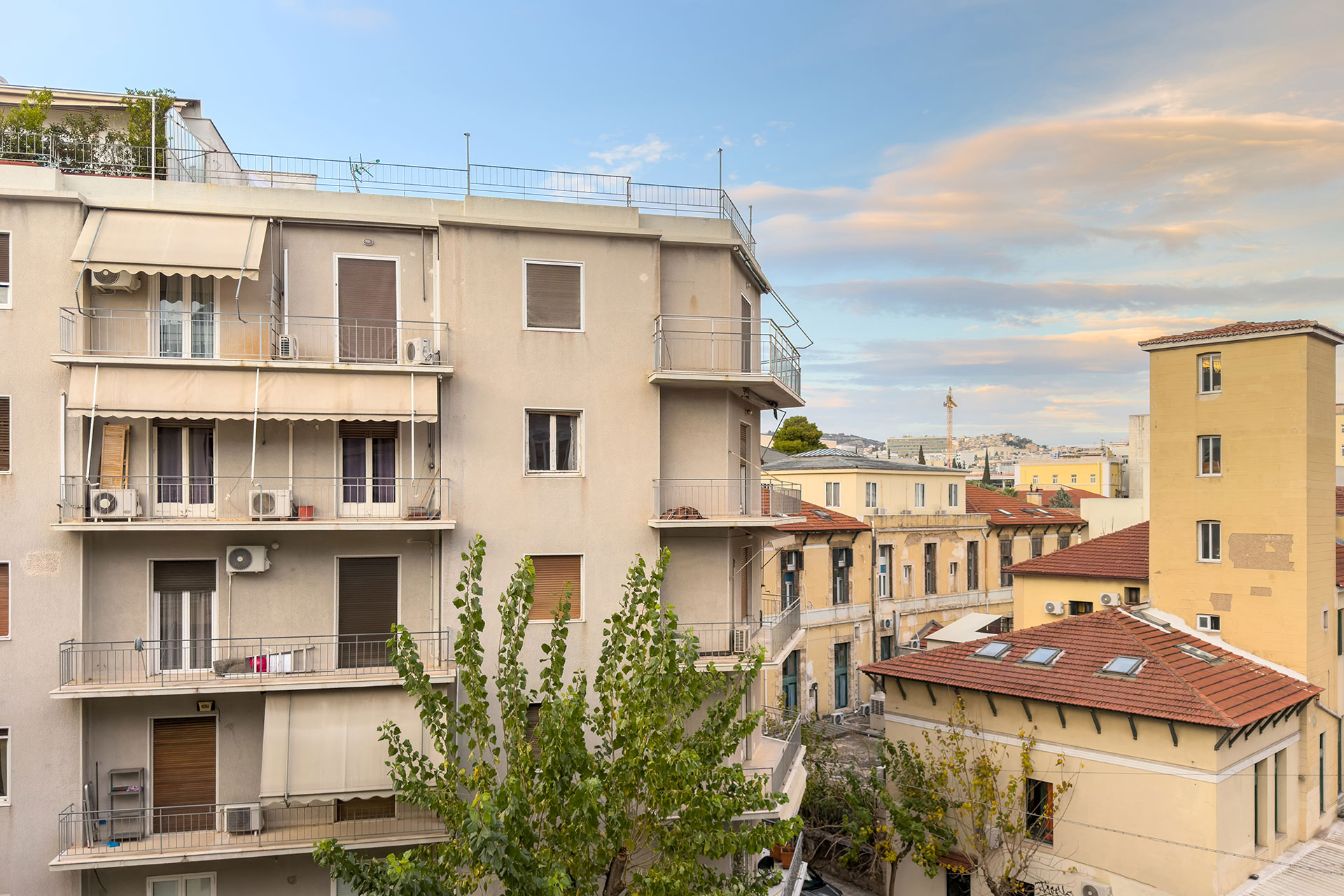
Eleven at night, late August, on a rooftop in Kypseli. The sun set three hours ago, and the concrete beneath my feet is still warm. It does not just hold the heat. It releases it back, hour after hour, until dawn. Multiply that by half a million, and you have Athens in August.
Nikos Vatopoulos, in “The ‘Sleep’ of Athens” (Kathimerini, 25 August 2026), describes the city with an accuracy that is uncomfortable, and he does not overlook its rooftops. He names them explicitly, alongside the removal of impermeable surfaces and the planting of more trees. I agree with every word. But I want to focus on something missing from his proposals, and from the public debate as a whole: the actor. “Work should be underway.” But who is supposed to do it?
Because the answer is not the municipality. Attica has 812,883 buildings. Of these, 554,632 have flat roofs, and 85.6% are constructed from concrete, with more than half having little or no thermal insulation. These are the figures from ELSTAT’s 2021 Buildings Census, and they are the numbers that matter in any discussion about the microclimate. The mass that absorbs the midday sun and releases that heat back into our bedrooms at night is not public infrastructure. It is private property. And the rooftop is the most cost-effective intervention we have per degree of cooling. Reflective surfaces have been measured at up to 15°C cooler at the surface than conventional materials of the same colour. A cool roof can lower indoor temperatures by two to five degrees in a building without air conditioning and reduce cooling loads by 10% to 40% in an air-conditioned building. In Marousi, the application of cool materials across 16,000 square metres resulted in a measured reduction in maximum ambient temperature of 1.2°C to 2°C.
Athenians of my generation remember the rooftop as a place. Sheets drying in the sun, an awning, conversations until three in the morning because it was unbearable inside. It was the liveliest part of the building. Today it is empty. But it has not stopped working. It is simply working against us. The municipality could plant every pavement in Athens and the city could still remain hot, because it does not hold the key to half a million rooftops. And the one key the state did have, it threw away. The state had one genuinely effective tool for persuading private owners to plant their rooftops: the environmental incentives provided under the New Building Code, or NOK. It lost it. Decisions 146 to 149/2025 of the Plenary Session of the Council of State did not find those incentives environmentally harmful. Quite the opposite: they expressly recognised that the incentives were driven by the need to address climate change. What the Court found unconstitutional was their blanket application through automatically issued building permits, without urban planning. It also struck down the provision allowing a 35-square-metre structure on top of a planted roof because, in the Court’s words, it distorted the purpose of the law. It also rejected treating a swimming pool as “planting” in conditions of water scarcity. Rightly so, on all three counts.
The diagnosis may have been correct. The treatment certainly was not. The Court showed us the way forward: incorporate the incentives into Local Urban Plans. Instead, what was chosen was the “environmental equivalent” introduced by Law 5197/2025: payment, at rates subsequently set by presidential decree. Those provisions were then challenged as well, with the case heard by the Plenary in March 2026. So we were left with frozen incentives, pending litigation and a price… When your head hurts, you do not cut it off. And shade cannot be paid for. A planted roof either exists or it does not.
The cost of this is not only thermal. It is institutional too. In April 2026, as the Sustainable Building Council Greece, we submitted a memorandum containing eight proposals to the Minister of Environment and Energy. The eighth called for a methodology to assess the climate adaptation of buildings, based on Article 9 of the EPBD, linked to Energy Performance Certificates and KENAK, the Greek Regulation on the Energy Performance of Buildings. Put simply, a way to measure whether a building can withstand heat, not only whether it consumes little energy. Since then, Greece has only partially transposed the Directive through Law 5215/2025. It received a letter of formal notice from the European Commission, together with eighteen other Member States, for failing to submit the draft National Building Renovation Plan. Then, on 15 July 2026, came a second letter, this time alongside the other twenty-six Member States. The fact that everyone received one is no excuse. It is a measure of how far behind Europe is on an issue that we are experiencing earlier and more intensely than most. So we froze the NOK incentives while delaying the framework that should have replaced them. This is not a legal technicality. It is a question of institutional credibility.
Then there is the question of scale. The individual building, as we know well, is too small a unit to change temperature. The city block is not. And here stumble over the particular reality of the Greek apartment building, where the rooftop is generally a common area, often with exclusive-use rights assigned to an individual owner, and every decision has to pass through a general assembly. Look at what we did last year.
Under Law 5215/2025, we made it possible to install renewable energy systems on 40% of a rooftop with the approval of owners representing 51% of the building’s ownership shares. In other words, we found a majority that allows us to generate electricity from the rooftop. We never looked for one that would allow us to create shade and greenery.
Vatopoulos writes that the city should be one enormous construction site. I agree. But that construction site does not begin on the pavement. It begins above our heads. Athens will not cool from the pavements upwards. It will cool from its 554,632 rooftops down.
Published by STIRIXIS Group as a leadership perspective from its President & CEO. Alex Athanassoulas originally wrote this article in his institutional capacity as President of Sustainable Building Council Greece (SBC Greece), responding to Nikos Vatopoulos’ “The ‘Sleep’ of Athens” in Kathimerini. The article is reproduced here in English for the STIRIXIS Group audience.
stirixisgroup.com | advance@stirixis.com
Follow STIRIXIS Group on LinkedIn
Explore the STIRIXIS Group perspective on climate adaptation as a strategic design and investment decision → The Next Upgrade Is Not a Product