

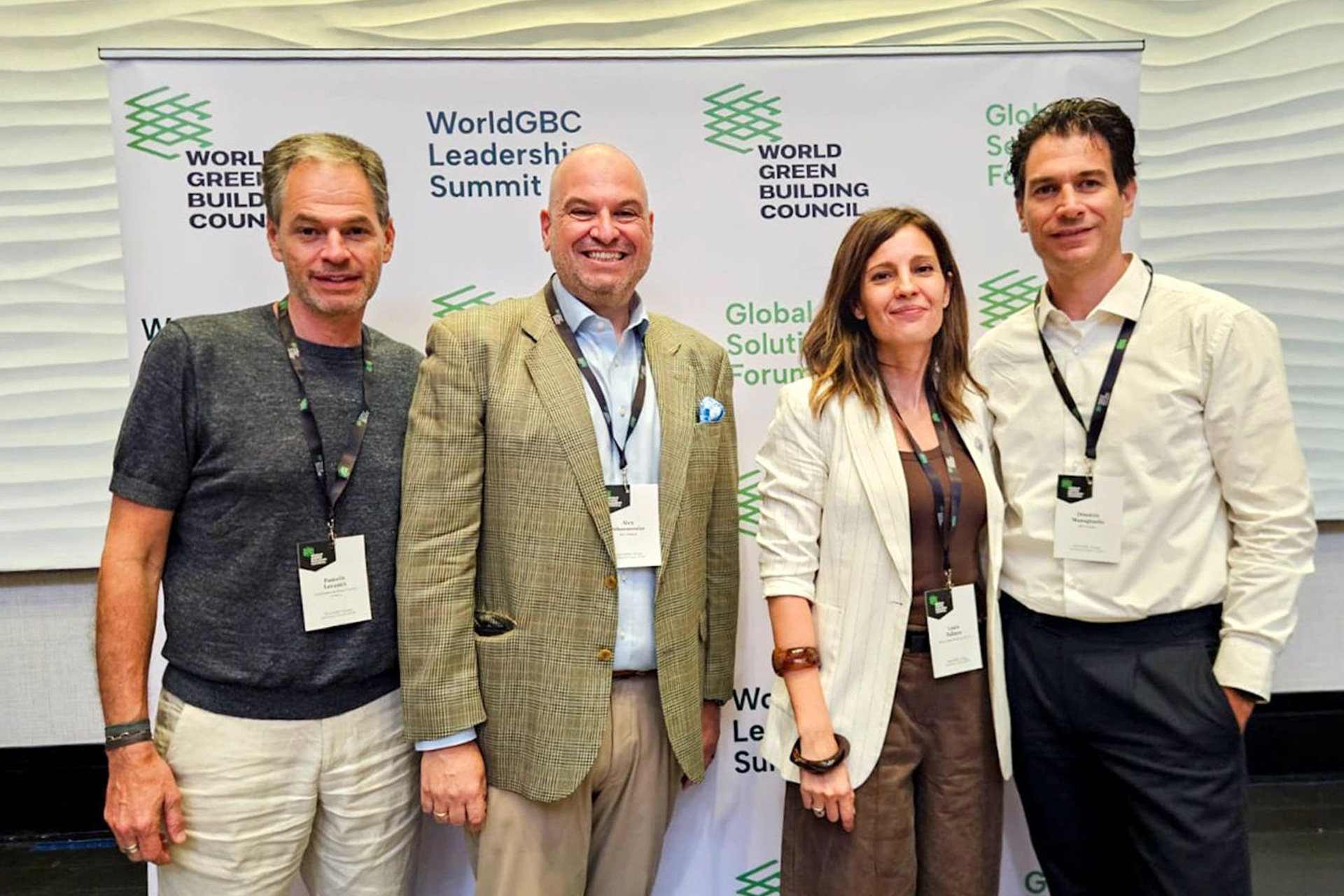
Left to right: Pantelis Levantis, Board Member, SBC Greece; Alex Athanassoulas, President, SBC Greece; Laura Pallares, Head of Europe, WorldGBC; Dimitris Managoudis, Vice President, SBC Greece at the WorldGBC Global Solutions Forum 2026, London.
Photo: World Green Building Council
Alex Athanassoulas, President of SBC Greece and President & CEO of STIRIXIS Group, represented SBC Greece in London on 22–23 June 2026 at the WorldGBC Global Solutions Forum and Leadership Summit, a flagship gathering focused on scaling sustainable transformation across the built environment.
Held in partnership with UKGBC as part of London Climate Action Week 2026, the WorldGBC Global Solutions Forum and Leadership Summit brought together Green Building Councils, business leaders, governments, sustainability experts and representatives of the finance community around one practical question: how can proven sustainable solutions move from ambition to wider adoption?
SBC Greece was represented in London by its President, Alex Athanassoulas, its Vice President, Dimitris Managoudis, and Board Member Pantelis Levantis, joining the European Regional Network meeting and the wider global forum.
The forum reinforced a conviction that SBC Greece has long held, and that increasingly defines the future of the built environment: sustainability can no longer be addressed at the scale of single buildings alone. The real unit of ambition is becoming the neighbourhood, the municipality and the city.
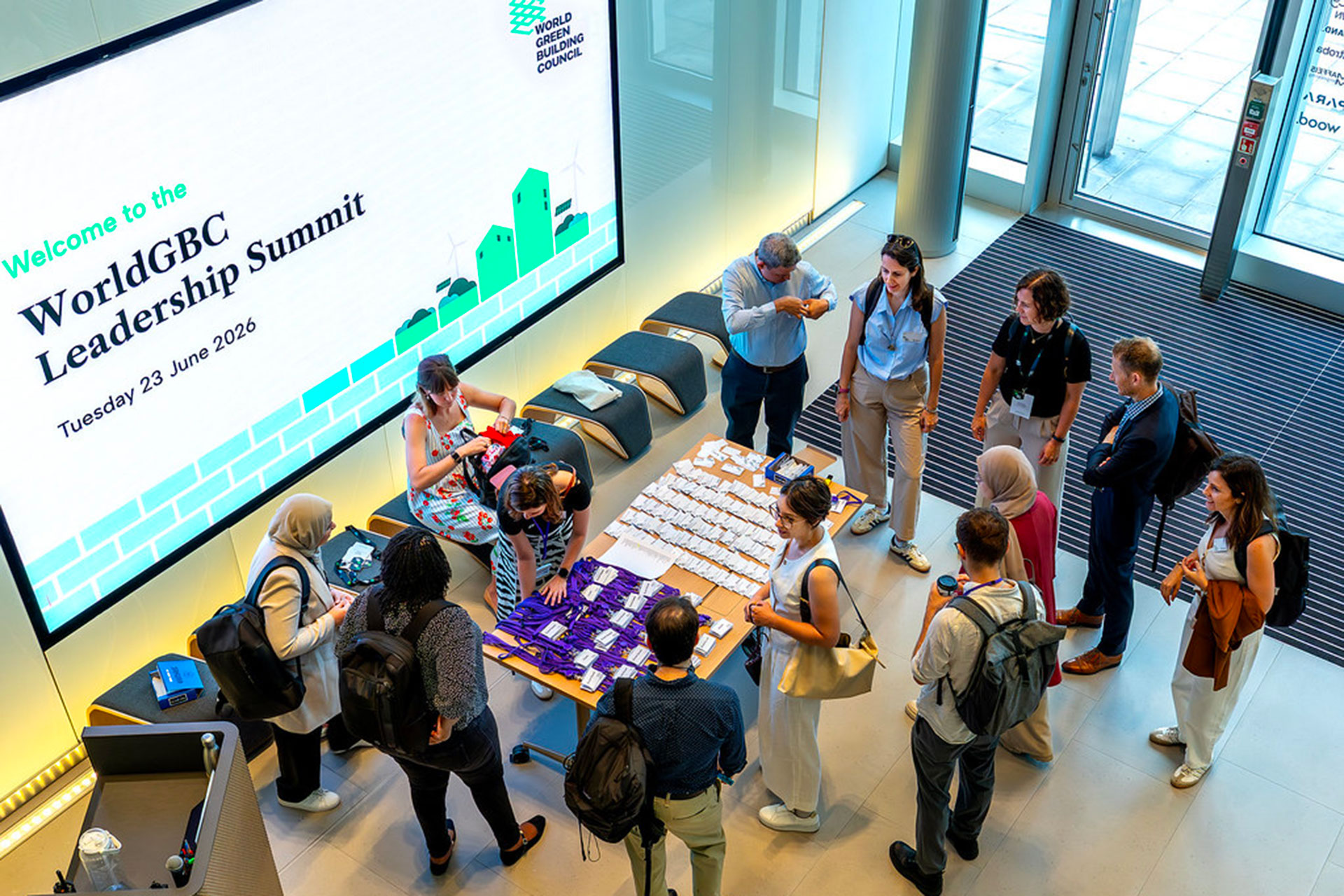
Delegates arriving for the WorldGBC Leadership Summit, 23 June 2026, London.
Photo: World Green Building Council.
The unit of ambition is no longer the building. It is the neighbourhood, the municipality, the city.
The Next Scale of Sustainable Transformation
The global green building movement is now operating through a network of more than 80 Green Building Councils, connecting thousands of members and influencing policy, industry practice and market expectations worldwide.
At this year’s forum, the conversation moved beyond isolated interventions and towards system-level transformation. Decarbonisation remained central to the agenda, but a broader question also emerged: how can the built environment reduce carbon while continuing to support health, resilience, circularity, social value and long-term prosperity?
This is the direction Alex Athanassoulas has long brought to STIRIXIS Group’s work through the Value Creation Circle™ — strategy, design, execution and evolution working as one continuous system. Buildings are not standalone objects. They are part of economic, social, environmental and urban systems. Their value depends not only on how they perform today, but on how they adapt, endure and contribute over time.
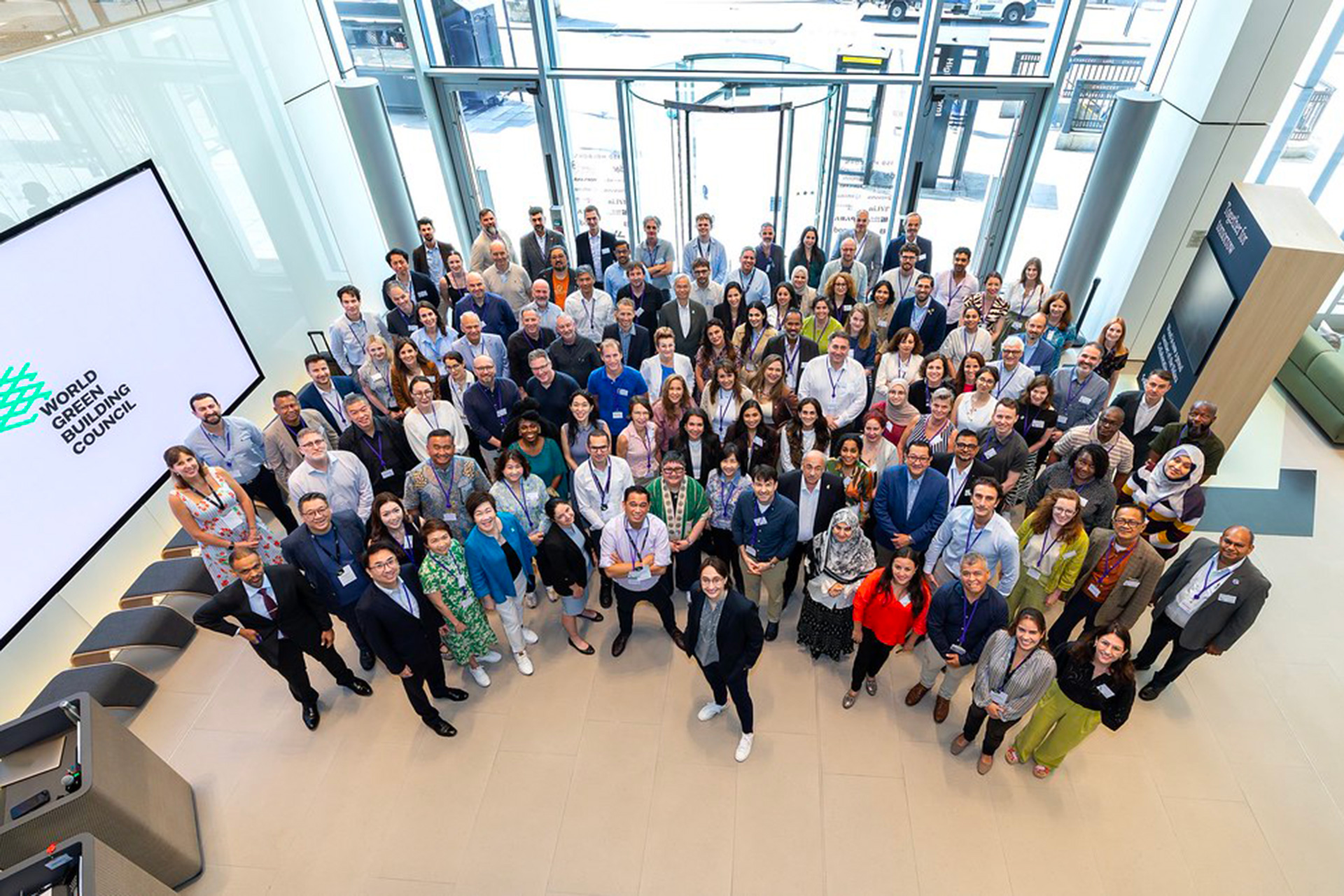
International delegates gathered at the WorldGBC Leadership Summit 2026, London.
Photo: World Green Building Council.
Scale matters. But the more important shift was in direction, not size.
Circularity as a Strategic Opportunity
One of the most important themes of the forum was circularity. Across Europe, construction remains one of the largest consumers of raw materials and one of the largest sources of waste. The shift away from a take-make-dispose model is therefore not only an environmental necessity. It is becoming a business, regulatory and investment reality.
Upcoming frameworks such as Digital Product Passports and stronger material traceability will make it increasingly important to understand what buildings are made of, how materials can be reused, and what value can be recovered at the end of a building’s life cycle.
This changes the way the industry must think. A building is no longer only a finished asset. It is also a material bank, a future source of recoverable value, and part of a circular urban economy.
A demolished building is not rubble.
It is a material bank.
Greece’s Opportunity: Activating What Already Exists
For Greece, the circularity agenda opens a significant opportunity. With a vast existing building stock, ageing assets, vacant properties and increasing pressure on housing affordability, the most sustainable solution will often not be to build more, but to reactivate, retrofit and intelligently reuse what already exists.
This is where sustainability meets the housing and urban regeneration agenda. Energy, heat, water and material reuse work better when they are approached at neighbourhood and municipal scale, not only asset by asset. Mapping empty stock, retrofitting tired buildings and turning idle assets back into useful space are not isolated technical tasks. They are strategic city-building work.
For a country with a long building tradition, a climate that demands adaptation and a large under-used stock waiting to be brought back to life, circularity is not a foreign concept. It is a return to durability, resourcefulness and responsibility, supported by modern tools, regulation and market logic.
The lowest-carbon, fastest, cheapest home is the one that already exists and is empty.
From Sustainability to True Long-term Value
For SBC Greece and STIRIXIS Group, the message from the WorldGBC Global Solutions Forum connects directly to the philosophy of Systems of Prosperity™, the conviction that lasting value comes from treating strategy, design, execution and evolution as one closed loop, not four separate hand-offs.
Sustainability is not an add-on to design. It is not a certification exercise or a technical checklist. It is part of how long-term value is created, protected and multiplied.
From workplaces and education environments to public assets, hospitality, residential developments and mixed-use destinations, the future belongs to projects that can respond to changing needs, reduce waste, improve performance and contribute meaningfully to the communities around them.
The built environment now faces a clear challenge: to move faster from proven ideas to scalable action.
SBC Greece and STIRIXIS Group remain committed to this transition, orchestrating strategy, design, execution and evolution into the kind of self-reinforcing prosperity that serves people, places and the long term.
Read Alex Athanassoulas’s latest reflection on long-term value at city scale → From Single Buildings to Whole Cities