

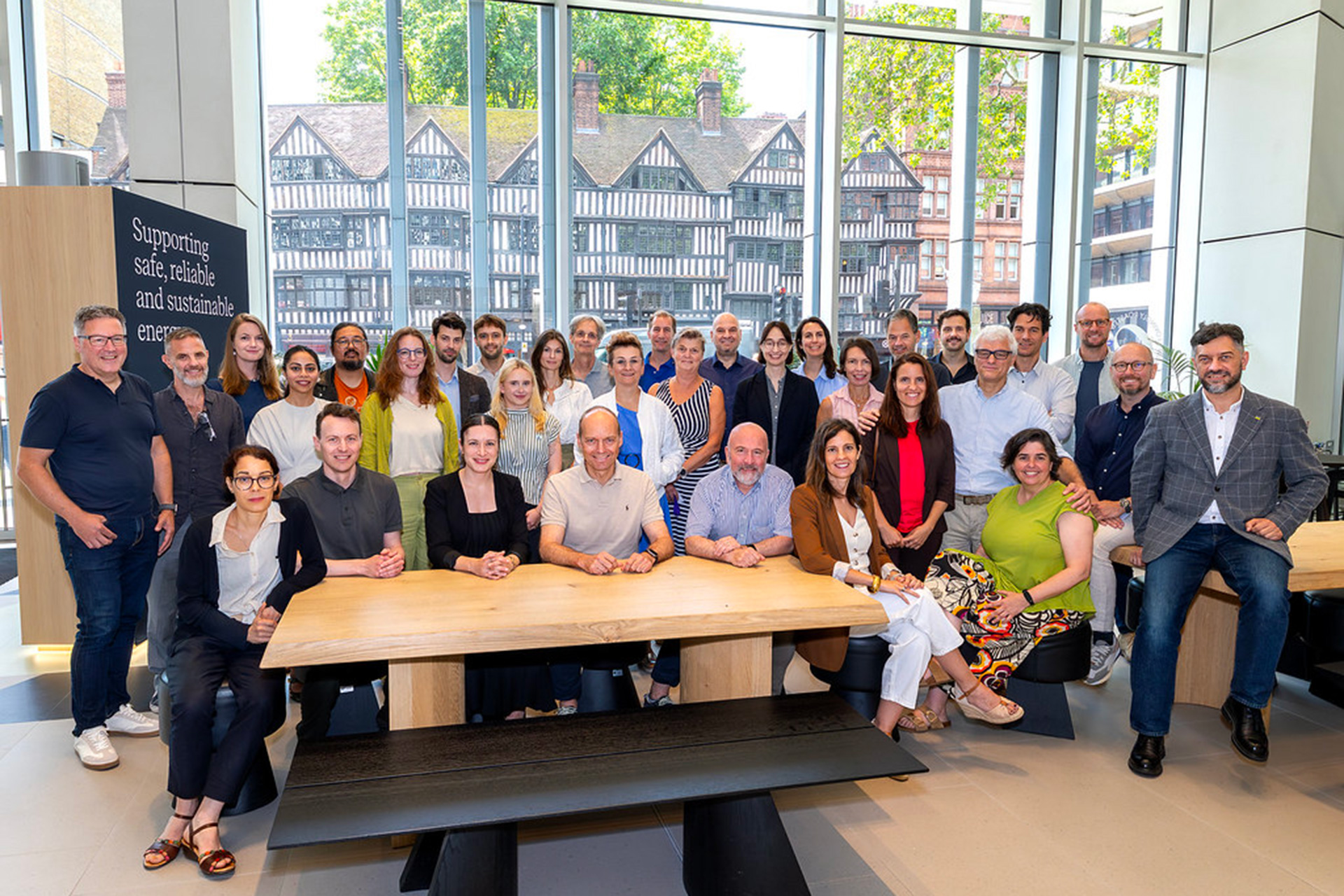
SBC Greece joined Green Building Council leaders at the WorldGBC European Regional Network meeting, London. Alex Athanassoulas, President, SBC Greece, is pictured centre, next to Cristina Gamboa, CEO, World Green Building Council.
Photo: World Green Building Council.
Reflections from the WorldGBC Global Summit.
By Alex Athanassoulas, President, SBC Greece | President & CEO, STIRIXIS Group
I came back from the World Green Building Council Global Summit with one conviction sharpened above all others: the unit of ambition is no longer the building. It is the neighbourhood, the municipality, the city.
The network SBC Greece sits within is more substantial and impactful than ever. More than 80 Green Building Councils, over 51,000 members, more than 5 billion square metres of certified space, policy moving in 30 countries. This year it grew again, welcoming councils from Ethiopia and Ghana to Belgium and Saudi Arabia. Scale matters. But the more important shift was in direction, not size. WorldGBC’s 2025 to 2027 strategy organises the work around three guiding goals: the total decarbonisation of the built environment, healthy and resilient communities, and the regeneration of natural systems through a real circular economy.
The 2030 targets attached to them are not slogans. Falling short of them is no longer an ethical failing. It is a balance-sheet event.
“Falling short of them is no longer an ethical failing. It is a balance-sheet event.”
Why Circularity is the European Story Now
This is where Europe is moving fastest, and where Greece can lead rather than follow. Construction in Europe consumes close to half of all the raw material we extract and generates more than a third of the continent’s total waste. That is not a footnote. It is the largest waste stream in Europe by weight, and the take-make-dispose model behind it is ending. The revised Construction Products Regulation and the coming Digital Product Passports will, within a few years, make the question ‘what is actually in this building, and where will it go’ answerable for the first time. Materials become traceable. End-of-life becomes a business, not a skip.
We already recover around 70 percent of construction and demolition waste on paper. The uncomfortable truth, which the European Environment Agency states plainly, is that most of it is downcycling, crushed concrete sent to road base. The real prize is reuse. A demolished building is not rubble. It is a material bank: reclaimed steel, structural elements with decades of life left, components that can be sold on rather than thrown away. Pre-demolition audits and materials passports turn that bank into value.
From the Building to the City
Roughly 80 percent of the buildings that will stand in 2050 already exist today. That single fact reorders everything. The carbon, the cost and the opportunity sit overwhelmingly in the stock we already have, not in what we will build next. And that stock cannot be fixed one building at a time. Energy, heat, water and material reuse all work better shared across a block or a district than chased apartment by apartment. The municipality, not the plot, is the right scale for retrofit and for a circular materials hub serving a whole neighbourhood.
This is also where sustainability meets the housing crisis, and where the idea of ‘sufficiency’ earns its place. Efficiency asks how to do the same with less. Sufficiency asks the harder question: do we need to build at all, when so much already stands empty? Greece does not have a shortage of buildings. It has a utilisation problem. The 2021 census counted more than 2.2 million vacant assets, among the highest shares of empty homes in Europe, with over 1.8 million of them sitting completely idle, offered for neither sale nor rent. Across the same years, house prices in Athens and Thessaloniki have nearly doubled.
“Greece does not have a shortage of buildings. It has a utilisation problem.”
Put those two facts side by side and the conclusion is uncomfortable but clear. We are arguing about how to build our way out of an affordability crisis while millions of homes sit closed and dark. The lowest-carbon, fastest, cheapest home is the one that already exists and is empty. Bringing a vacant flat back into use avoids the embodied carbon of a new build and adds real supply exactly where people need to live.
The climate agenda and the housing agenda point to the same answer. And that answer is municipal-scale work. Mapping the empty stock, retrofitting tired blocks, turning idle buildings back into homes. This is neighbourhood and city work, not a series of one-off villas. Greece is well placed for it: public renovation funding through Greece 2.0, a climate that forces adaptation rather than letting us defer it, a building tradition that worked in stone meant to last for generations, and now a vast, under-used stock waiting to be brought back to life.
Circularity is not a foreign import here. It is a return to how we always built, given a modern name and a market behind it. The buildings we choose to save, reuse and reopen are where people will live their lives. Millions of them, right now, are locked and dark.
“Circularity is not a foreign import here. It is a return to how we always built, given a modern name and a market behind it.”
SBC Greece intends to make turning that around the standard, not the exception.
For STIRIXIS Group, this is what True Prosperity™ looks like at city scale: not a single building performing well, but a neighbourhood’s worth of existing value brought back to life.
Read the full event coverage → Alex Athanassoulas at the WorldGBC Global Solutions Forum 2026