

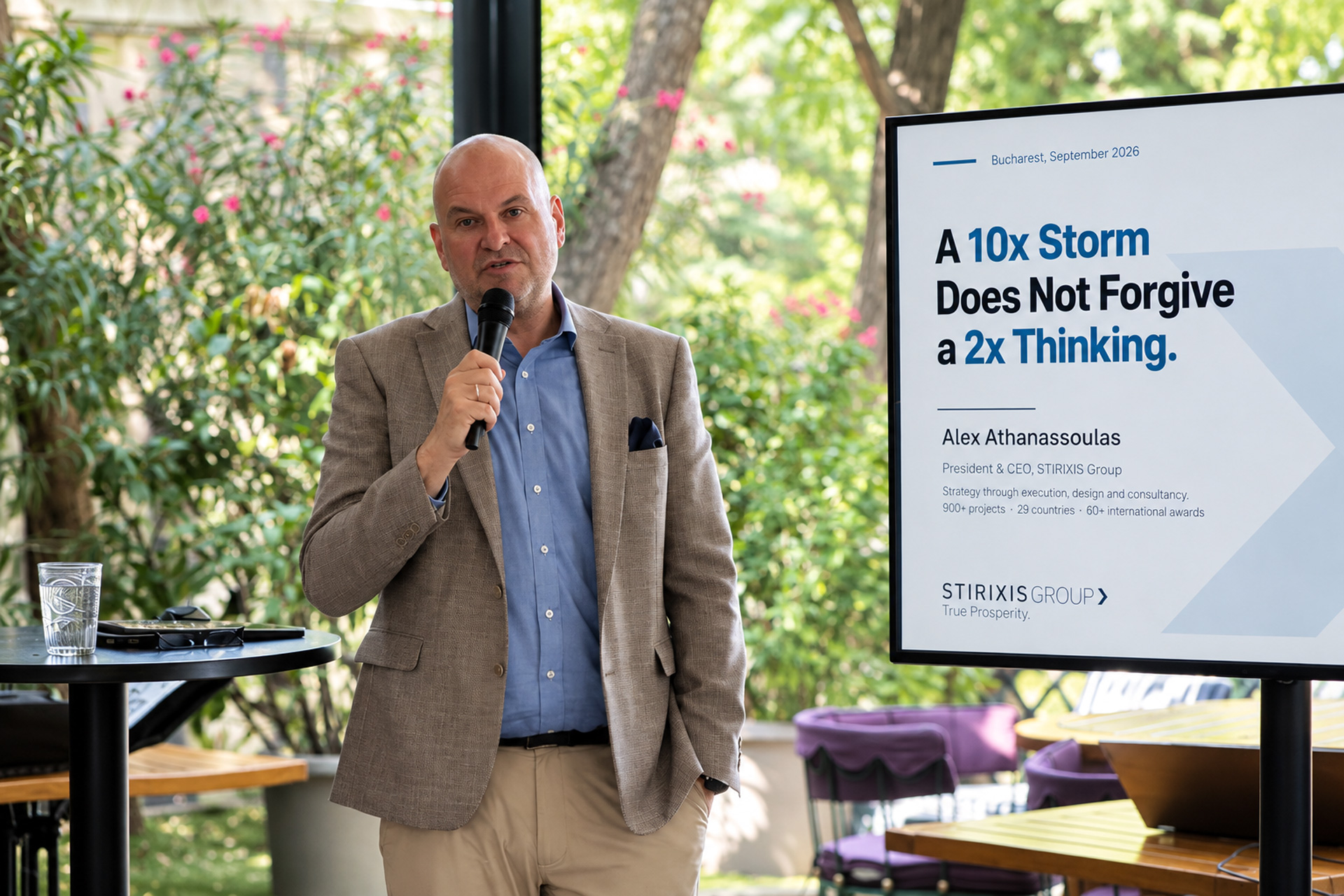
Alex Athanassoulas speaking at CEO Clubs Romania Executive Club in Bucharest, September 2026.
Designing from the Future
What if the walls protecting today’s business are the ones that break it tomorrow?
At CEO Clubs Romania in Bucharest, Alex Athanassoulas opened with an image that stops a room: when a hurricane comes, the world’s navies send their ships out of the harbour. Not in. Out. Into open water. In a great storm, the harbour is the most dangerous place on the coast. The ship is lifted, thrown, and smashed against the very walls built to protect it.
The proposition matters because business risk rarely announces itself as failure. A profitable offer, a proven operating model, a familiar customer journey or a successful asset can continue performing while the conditions that made it valuable are already changing.
The harder leadership question is therefore not simply what is changing. It is which part of today’s success is holding the organisation to the dock.
When Forces Converge
Alex named eight forces reshaping the business environment: energy, mobility, geopolitics, telecommunications, AI, robotics, education and retail. The strategic problem is not the length of the list. It is that the forces do not arrive one at a time. They feed each other.
AI accelerates robotics. Robotics reshapes energy demand. Energy reshapes geopolitics. And geopolitics reshapes a supply chain by Tuesday. New behaviours alter what customers expect from stores, workplaces, education and services. A decision in one system changes the conditions in another.
An organisation can therefore monitor every trend and still miss the shift if each is assessed separately against assumptions that are never challenged. The greater risk is that the response can still look entirely reasonable: prudent, defensible and built around what has worked before, even as the conditions supporting it begin to expire. The villain of a storm is never the storm. It is the reasonable plan.
“This is not eight storms. It is one storm, with eight winds.”
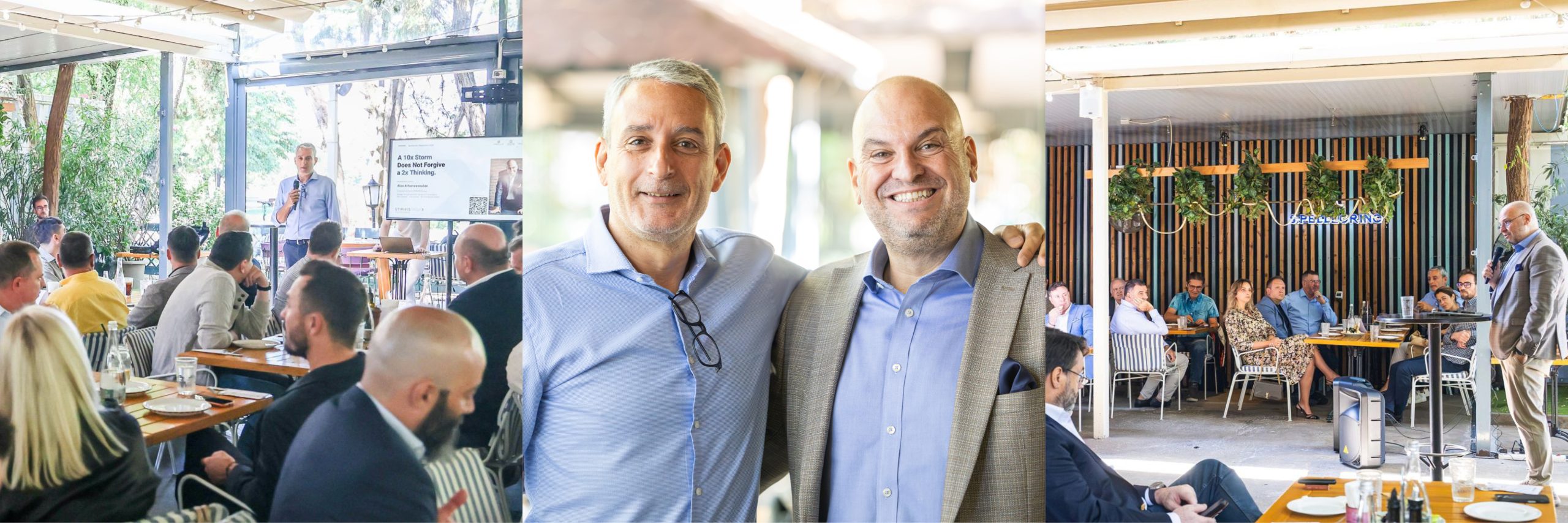
Alex Athanassoulas addressing CEO Clubs Romania Executive Club, with founder Sotiris Chatzidakis, and in discussion with members of the Club in Bucharest, September 2026.
Seeing Before Certainty
This is where foresight becomes commercially useful. The work behind METALLAXIS examines signals for what they change in a decision: where demand may move, which assumptions are becoming fragile, what an investment must be able to withstand, and what an organisation should prepare for before the evidence becomes obvious.
The objective is not to predict one future. It is to make better decisions in the present. For an investor, that may mean testing whether an asset being planned today will answer tomorrow’s demand. For a retailer, whether the store remains primarily a transaction point. For a corporate leader, whether AI improves the current model or changes the model itself.
What Must Leave
Alex has made that kind of decision before. During the Greek financial crisis, 80% of STIRIXIS Group’s income came from construction services: solid, familiar and profitable work. Protecting it was the reasonable plan. Instead, the Group walked away from that dependence, moving from building buildings to building concepts, strategies and businesses. Today STIRIXIS Group works across 29 countries, on more than 900 projects.
The lesson is not to abandon what works. It is to recognise when the reasonable plan has become the constraint. Transformation competes with the present for capital, people, management attention and time; if nothing leaves, it becomes another layer rather than a change in direction. This is where 10x stops being ambition and becomes a filter, forcing leaders to identify what can carry the future and what is being kept simply because it is profitable, familiar and already there. What has to be released is rarely a failure. It is usually a success.
“2x is addition. 10x is subtraction.”
From Vision to Execution
Subtraction creates capacity. The next question is whether an organisation can turn a different direction into reality. Alex’s keynote makes that shift explicitly: vision has to survive execution. Seeing what is coming is not the differentiator if the organisation cannot act on it.
That is where foresight connects to the Value Creation Circle™. Strategy defines where value should be created. Design gives the strategic choice tangible form. Execution turns intent into reality with one accountability. Evolution measures performance, absorbs what has changed and feeds that intelligence back into the next decision. It is the move from identifying the future to building for it: from foresight to one crew, one accountability.
The distinction is between familiarity and safety. Familiarity tells an organisation what has worked. Foresight asks whether it will continue to work. Strategy decides what must change. Execution determines whether the organisation actually gets somewhere else. Alex said it from the stage in five words. Safety has changed its address.
“Build backwards from the company you intend to be in 2031. Not forwards from the one you are.”
Next Step
Which current success is holding your organisation to the dock? And if those forces were read together rather than one at a time, what would you invest in, redesign, or stop carrying?
→ START A STRATEGIC CONVERSATION
Follow Alex Athanassoulas on LinkedIn