

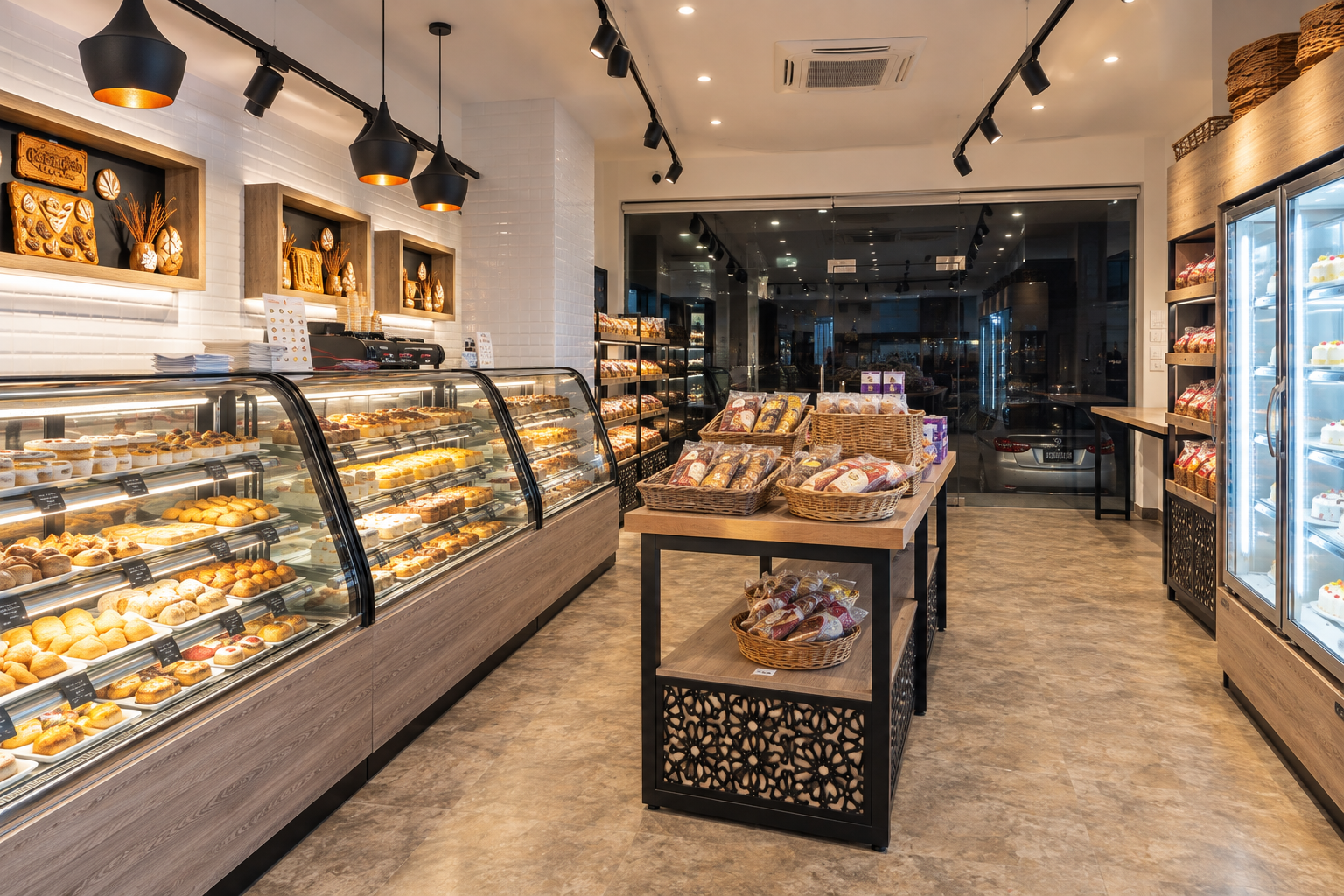
Modern Oman Bakery, a STIRIXIS Group project combining retail, hospitality and product experience within one destination.
When quality is the entry ticket, what earns the choice?
by Elena Daliani, Chief Client & Operations Officer
SUMMARY
As quality becomes the baseline across Gulf mixed-use, retail and hospitality destinations, preference becomes the real competitive question. Defining the proposition early can shape stronger decisions, repeat visits and long-term destination value.
The pipeline of quality mixed-use, retail and hospitality destinations in the Gulf is expanding. Architecture, F&B, international brands and landscaped public realm are increasingly part of the expected baseline, making them less sufficient on their own as differentiators. That is progress. It also changes the competitive question.
When more developments can offer quality, quality becomes the entry ticket. The question shifts from whether a destination is good to why people will choose this one.
From Attraction to Preference
A development can attract attention without earning preference. A major opening creates curiosity. An architectural statement creates visibility. A strong tenant mix creates reasons to visit. Events can create temporary traffic.
Preference is harder. It exists when people begin choosing one destination over the alternatives available to them, returning without needing a special occasion and incorporating it into their routines. That distinction matters commercially.
The competitive set is not limited to developments that look similar on a masterplan. A restaurant district competes with another restaurant district, but it also competes with a hotel, a mall, a neighbourhood, a beach club, home delivery and every other claim on someone’s discretionary time. The real competition is for choice, time and return.
What I observe consistently is that the developments which earn preference are not always the most ambitious ones. They are the ones where the proposition was defined early enough to shape actual decisions — tenant selection, programme, public realm, operations — rather than being applied as a layer of communication after those decisions were already fixed.
When more developments can offer quality, quality becomes the entry ticket rather than the reason for preference.
The Preference Test
Before a proposition is translated into architecture, tenant mix and experience, five questions deserve clear answers:
Who chooses us?
Not simply the demographic profile. Whose behaviour are we trying to influence?
Instead of what?
What would that person otherwise do with the same hour, evening or weekend?
For what recurring reason?
Opening curiosity is not a repeat proposition. What creates the second, fifth, or twentieth visit?
Where is the difference experienced?
If the proposition cannot be identified in the arrival, movement, programme, service, public realm or operating model, it risks remaining a marketing statement.
Can the organisation deliver it consistently?
A proposition that depends on conditions the operations cannot sustain is not yet a proposition.
The Operational Test
The fifth question deserves its own section, because it is one that development propositions can easily overlook.
A preference proposition that cannot be operationalised remains an aspiration. The gap between what a destination promises and what it delivers at scale — across weekdays and peak periods, across years of operation rather than opening months — is where differentiation can erode.
This requires a different kind of rigour earlier in the process: not only what experience the destination aspires to create, but whether the management model, operating standards, staffing, maintenance and asset lifecycle can sustain it. Whether the design decisions that create distinctiveness can be maintained at operating cost. Whether the tenant relationships support the proposition or gradually dilute it.
One recurring failure I see is not a weak proposition. It is a strong proposition that was never connected to the operational and execution decisions that would have made it real.
These questions move differentiation upstream. They force the destination to define the behaviour it wants to earn before individual components are designed.
The Weekday Test
There is another useful test. What happens on an ordinary Tuesday?
Weekends, launches, festivals and major events can conceal weaknesses in a proposition. Demand is concentrated. Programming creates energy. People arrive with a reason already supplied to them.
Tuesday is less forgiving.
- Does somebody come for breakfast and remain for a meeting?
- Can a resident use the destination without planning an occasion around it?
- Does the public realm give someone a reason to stay between activities?
- Can hospitality, retail, work, leisure and community uses reinforce one another throughout the day?
- Does the place still have a recognisable purpose when nothing special is happening?
A destination that works only when programmed continuously carries a different operational burden from one that has preference built into its everyday proposition.
Design the Reason to Return
This changes the role of design. The objective is not to add more attractions. It is to translate a chosen proposition into a system that people can experience: the right uses, adjacencies, journeys, thresholds, services, rhythms and operational decisions working together.
Sometimes the strongest differentiator may be convenience. Elsewhere it may be cultural relevance, discovery, wellness, community, hospitality, family use or the ability to move naturally between different parts of the day. There is no universal formula. If every destination receives the same list of desirable ingredients, those ingredients eventually stop differentiating it.
The value lies in determining which combination belongs to this market, this audience and this development, and making that choice tangible.
Before the Choice is Designed
The Gulf does not have a shortage of ambition. Its next competitive challenge will increasingly be what happens when ambitious, well-designed developments compete with other ambitious, well-designed developments. At that point, adding another amenity is unlikely to be enough.
The stronger question comes earlier: What are we asking people to prefer us for?
Answer that before the concept, tenant mix and experience are fixed, and design has something much more valuable to deliver. It has a reason to be chosen.
Planning a mixed-use, retail or hospitality destination?
STIRIXIS Group’s Preference / Proposition Workshop tests the audience, competitive alternatives, recurring reason to visit and operating credibility before concept, tenant mix and experience decisions are fixed. From there, the proposition guides design, execution and post-opening evolution, so that the reason for preference becomes tangible in the place itself.
To discuss your destination, contact advance@stirixis.com