

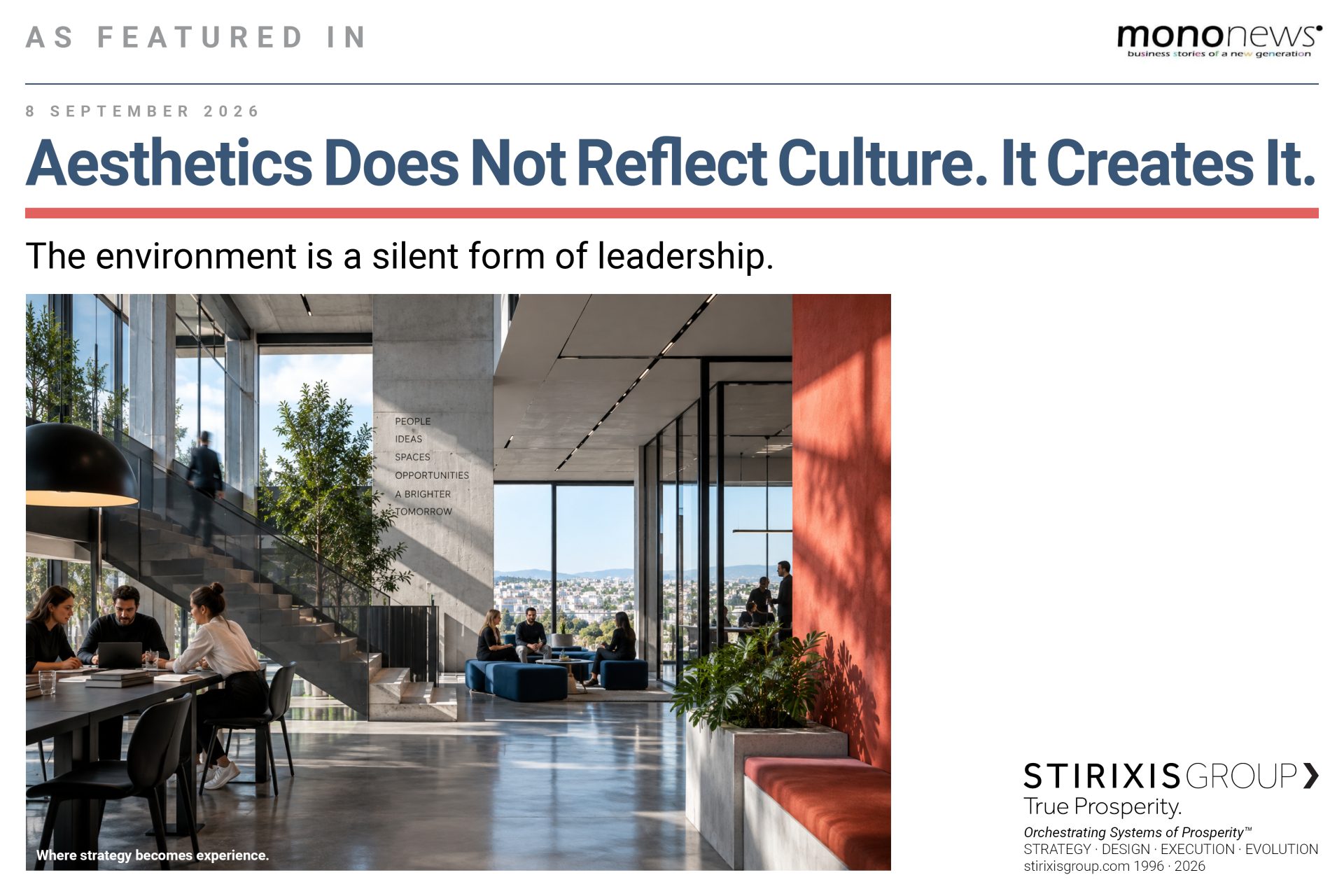
Why the environment an organisation builds says more about its values than any report it publishes.
By Elena Kyrnasiou-Athanasoula, VP and Managing Director, STIRIXIS Group
Every organisation audits its finances. It revisits its strategy. It measures the performance of its people. Yet it rarely examines the one thing that shapes how everyone behaves every day, without asking anyone’s permission: the environment they work in. And I do not mean only whether that environment functions. I mean its aesthetics.
In our culture, aesthetics is treated as a question of taste, something added at the end if there is budget left. Years of working across markets that could not be more different have led me to the opposite conclusion.
Aesthetics is silent leadership. It governs how people behave even when nobody is watching them. I call this Aesthetics Create Ethics. Ludwig Wittgenstein, one of the most important and influential thinkers of the twentieth century, wrote that ethics and aesthetics are one. In the life of an organisation, one produces the other. Aesthetics creates ethics.
Space as Silent Policy
An environment states its expectations before the first word is spoken. Order, light and evident care say that standards exist here and that they deserve respect. Carelessness says the opposite, that things are done roughly here and that nobody minds. No compliance manual persuades as effectively as the space people see and touch every morning.
This is why I describe aesthetics as an organisation’s silent policy. It is never announced and it is enforced continuously. When it contradicts the declared strategy, aesthetics wins, because people experience the space with their bodies and read the strategy on a page.
The Domino: from the Individual to the Collective
Here a chain begins that we rarely follow to the end.
A behaviour that repeats becomes an attitude. An attitude does not stay with one person. It passes to the desk beside it, becomes the unwritten rule of a team, and eventually determines how an entire organisation works. Individual ethics becomes collective ethics. And collective ethics becomes aesthetics again, because aesthetics is not only a space. It is how a company speaks to its clients, how it presents its work, how it receives a visitor, how it attends to the details it could easily ignore.
The circle closes where it opened. An environment shapes behaviour, behaviour shapes culture, and culture returns as the aesthetics of the whole organisation. Aesthetics is not surface. It is the visible form of a company’s character.
The Cost of Misalignment
In management terms, culture is either an asset or a liability, and it is built or eroded daily through the environment. The most expensive gap I find in organisations does not appear in the numbers. It is the distance between the values a company declares and the environment it occupies. A mission statement hung on an indifferent wall is contradicted by the wall.
The point that matters is that this translates into results. In a recent workplace project, the new strategic layout led people to choose to come to the office more often, with full hybrid working available to them. Meeting rooms genuinely supported collective work instead of obstructing it. Shared dining areas created contact between teams that would otherwise never have met. Nobody imposed any of it. The space made it the natural choice. That is not taste. That is alignment between a space and the people in it.
The Test of Time
The value of this approach is not judged on opening day. It is judged years later, when the environment is still working, still raising the standard of behaviour rather than wearing it down. This is why we treat design as a cycle rather than a delivery, what we call at STIRIXIS Group the Value Creation Circle™. We return once a space is in use, we measure what happened, and we adjust. The ethics of a space, like the ethics of an organisation, are proven over time and not on first impression.
Experience across radically different scales and cultures, from Greece and Europe to the Middle East, India and America, confirms one constant. An environment that respects people is repaid. An environment that ignores them produces friction. The geography changes. The mechanism does not.
Intention as the Beginning of Ethics
For anyone in a position of leadership, the practical conclusion is straightforward. The aesthetics of an organisation is the most honest statement of what it truly values, more honest than any corporate responsibility report. Space does not reflect a culture. It creates one.
So, the question is not whether our environment shapes us, because it does either way. The question is whether we leave it to chance or take it on consciously. When we take it on with intention, space starts making people more collaborative, more transparent, more accountable. And it becomes clear that the beauty of intention is not something we add at the end. It is where ethics begins.