

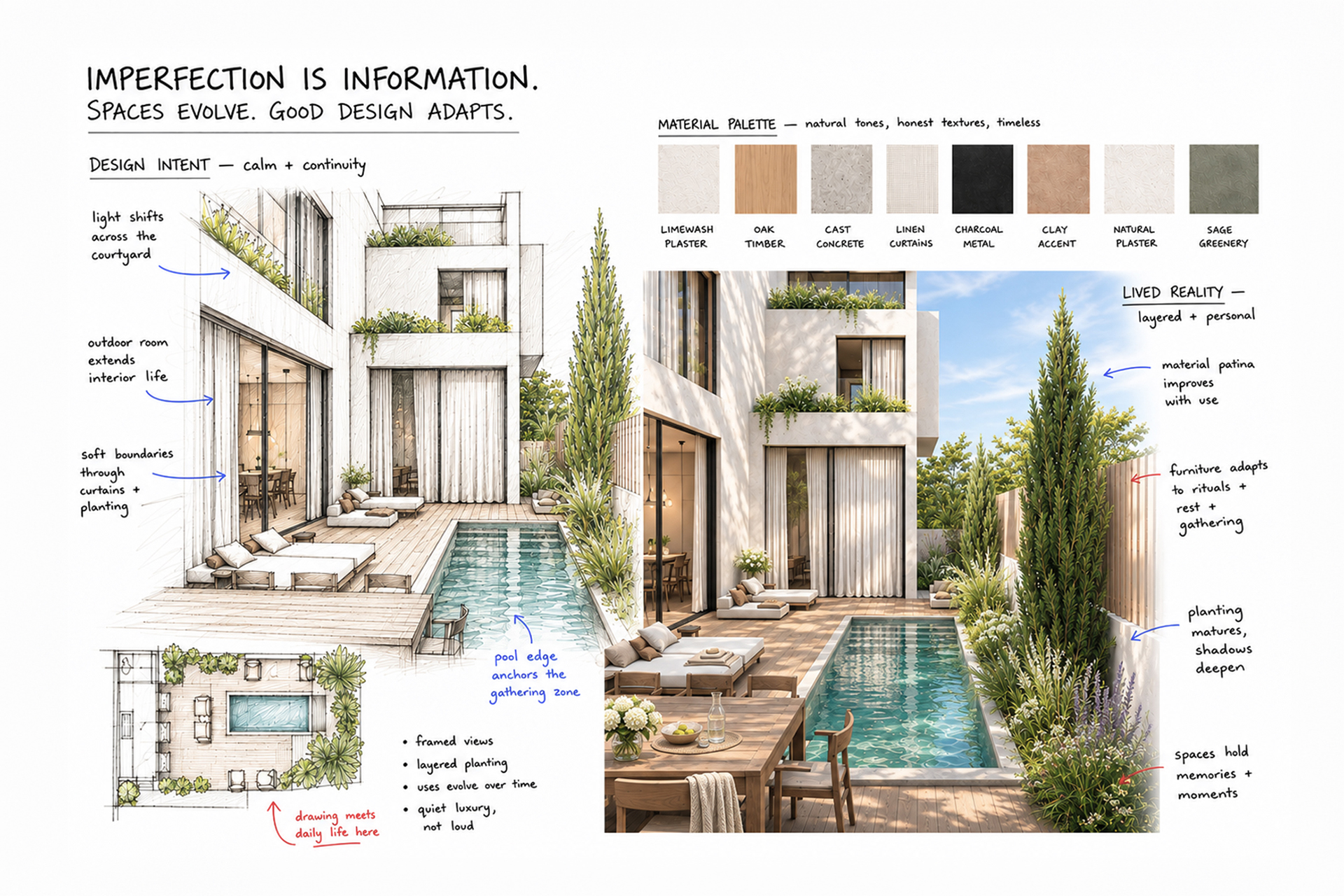
On control, adaptation and designing for real life.
By Afroditi Karaiskou, Head of Design, STIRIXIS Group
SUMMARY
Afroditi Karaiskou, Head of Design at STIRIXIS Group, reflects on the place of imperfection in architecture. She considers what happens when precise drawings meet the habits, adaptations and unexpected uses of everyday life, and why leaving room for people can be an intentional design decision. Within STIRIXIS Group’s Value Creation Circle™, this perspective supports places that remain useful, coherent and responsive as needs evolve.
Architecture has a disciplined relationship with perfection. We draw straight lines, resolve junctions, align surfaces and control dimensions down to the millimetre. We produce images of spaces before they exist, often so complete that they leave little room for what will happen inside them.
Control is necessary. It protects quality, intention and clarity. Yet a building is not completed by the drawing, the render or even the handover. Its real test begins when people enter.
What Happens After the Drawing
Objects move. Habits form. Certain corners become more important than expected, while others are used in ways nobody anticipated. Materials begin to age. Light changes them. Repetition leaves traces. Slowly, the precision of the drawing meets the unpredictability of life.
“Perhaps imperfection begins exactly where control ends.”
This is where imperfection becomes a professional question, not an aesthetic preference.
Imperfection Is Not Carelessness
Imperfection does not mean accepting poor decisions, weak detailing or unresolved work. There is a clear difference between a space that is careless and a space that has been designed with enough intelligence to evolve.
Design still requires precision, discipline and intention. The question is not how to make everything fixed. It is what must be precise, what must remain consistent and where openness is needed for real use to take over.
Leaving Something Unresolved
We often speak about flexibility in architecture as something functional: movable partitions, adaptable furniture, spaces that can change use. But perhaps there is another kind of flexibility. A willingness to leave a certain amount of space – literally and metaphorically – for someone else to complete the story.
That can be uncomfortable for a designer. We are trained to make decisions. To resolve. To finish. But there may also be intelligence in knowing what not to decide.
When People Take Over
Some of the most interesting things that happen in buildings were never drawn exactly as they later appear. A chair moves toward the window. An informal meeting point appears. A surface becomes more beautiful through use. These are not failures of design. They are evidence that the space has begun to live.
Perhaps the role of architecture is not to eliminate imperfection. Nor to design it. But to create something strong enough to allow it.
Perhaps a space becomes truly complete only when we accept that it never really will be.
Explore STIRIXIS Group’s approach to design within the Value Creation Circle™.
Contact: advance@stirixis.com
Related Reading
Layers of Design | Article 01: When Time Becomes Part of the Design