

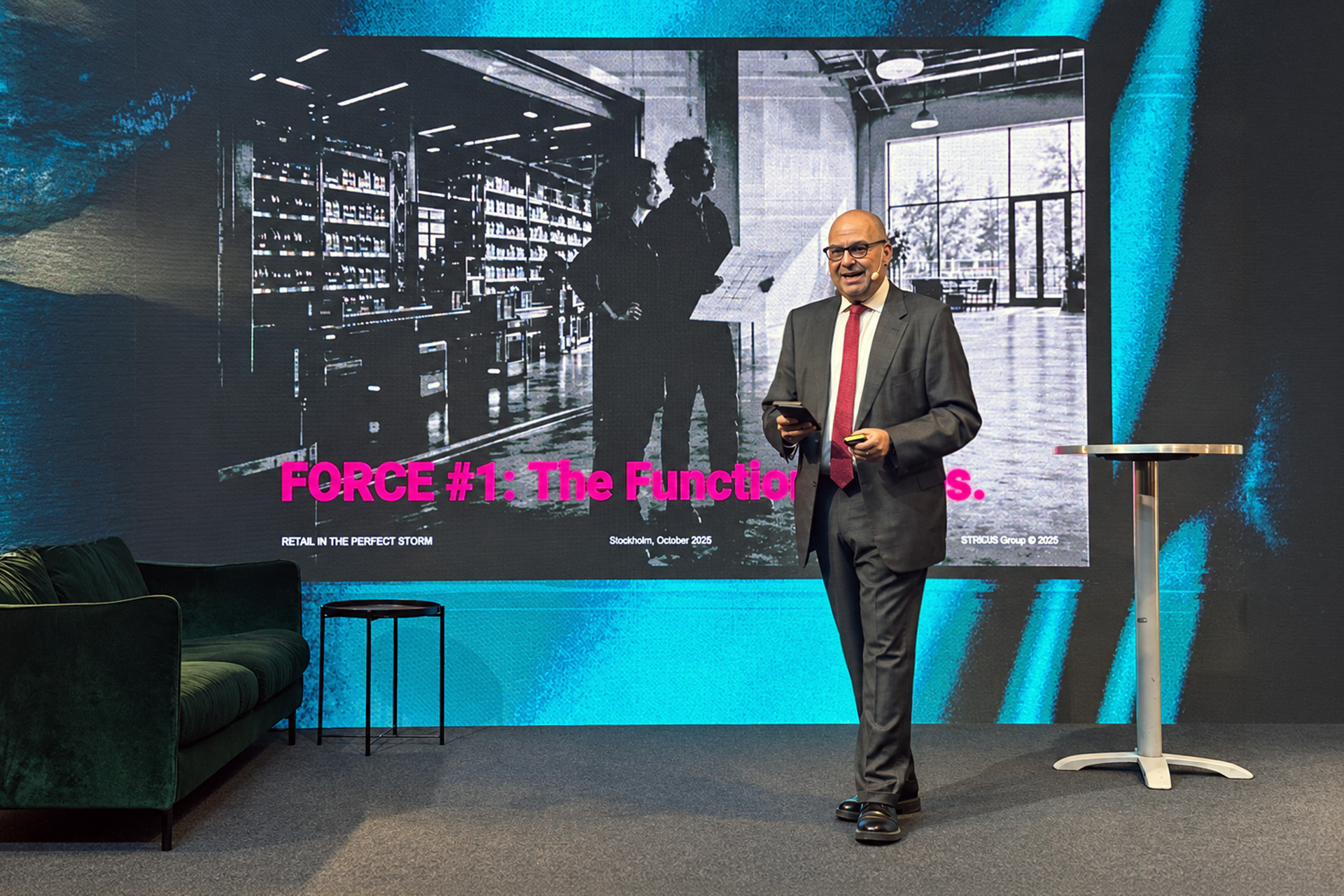
Alex Athanassoulas, President and CEO of STIRIXIS Group, at the Nordic Grocery Store Expo, Bubbelscenen, Stockholm, 7 October 2026.
The question of what a grocery store is for has just reopened.
By Alex Athanassoulas, President & CEO, STIRIXIS Group
SUMMARY
For more than a century, grocery retail has become increasingly efficient at removing friction between people and products. Now AI, demographic change, urban transformation and the renewed value of human trust are moving the moment of decision out of the store itself. The opportunity is to decide what the store becomes next.
For more than a century, grocery retail has moved in one direction: faster, easier, more functional. Self-service began that shift. On 11 September 1916, in Memphis, Clarence Saunders opened a shop with no counter in it and patented the idea the following year. The title on US Patent 1,242,872 is three words long: self-serving store. He did not invent convenience. He invented the grocery store with no person in it. Larger formats, automation and digital tools accelerated what he started.
Now the moment of decision is beginning to move away from the store itself.
AI can already compare products and prices before a shopper arrives. Recommendations influence choice. Connected devices can recognise needs before the customer actively does. The shift that matters is that comparison, choice and consent are moving out of the shop. In May 2026 Acosta surveyed 1,271 American shoppers. A third already use AI to shop. Of those, only one in five trusts it to complete a purchase, and four in ten have already bought a brand it recommended.
They do not trust it to buy. They have already let it choose.
That changes the role of the physical store.
Technology is only one force. Demographics are changing what people need from retailers and how they use them. Sweden offers a clear example: Statistics Sweden expects the share of the population over eighty to rise from six per cent to eleven. An ageing population and changing household structures are already influencing shopping and eating patterns. This is larger than a category opportunity. A doctor sees an older customer twice a year. A hospital sees her when it is already too late. A grocer sees her twice a week, for sixty years. No other business has that frequency of contact with a person’s health.
Cities are changing too. Across Europe, denser neighbourhoods, shorter journeys and more local patterns of everyday life are creating a different context for retail. That should favour the physical shop. The measured evidence is less comfortable. Research at the University of Gothenburg tracked twenty local functions across the city. In the neighbourhoods that changed most, population rose fifty-six per cent, healthcare ninety-four and schools eighty-four. Commerce rose four. Proximity is arriving, and it is not bringing retail with it.
At the same time, as functional choices become easier to automate, trust, familiarity, provenance and human judgement become more valuable. When the cost of a convincing lie falls to zero, the premium moves to whatever cannot be generated.
The strategic question is simple: “What is the store for?”
Retail has competed on product, then service, then experience. Today, experience itself is increasingly replicable. Purpose becomes the next source of differentiation: a clear decision about why the business should matter beyond the transaction.
Product connects a business to a customer at the moment of purchase. Service at the moment of contact. Experience at the moment of the visit. Every one of those is a moment, and a machine has just taken the moment of purchase. Purpose connects when the customer is nowhere near the building.
After thirty years working across the places where commerce happens, I have seen ambitious transformations lose value for one simple reason: nobody decided.
The sequence should be clear. Decide what the place is for. Build that decision into the environment. Then measure whether the decision survived.
It usually does not, and it rarely fails in the boardroom. It fails in the handovers, where somebody who was not in the original room makes a decision that costs nothing on a drawing and everything in the building.
At STIRIXIS Group, this is how we approach value creation. Strategy governs the process from the first question through design and execution, then returns through Evolution to measure whether the intended outcome was created. METALLAXIS strengthens the same process upstream, using signals and foresight to help organisations make better decisions before change becomes obvious. Its published method is called DECIDE, after the step that is most often skipped.
“Ambitious transformations lose their value for one reason. Nobody decided.”
The future grocery store will be built on what technology cannot replace: relevance, trust, human connection and a meaningful role in people’s lives.
For more than a century, the industry had a clear answer to the question of what a grocery store is for. That question is open again. And that is the opportunity.
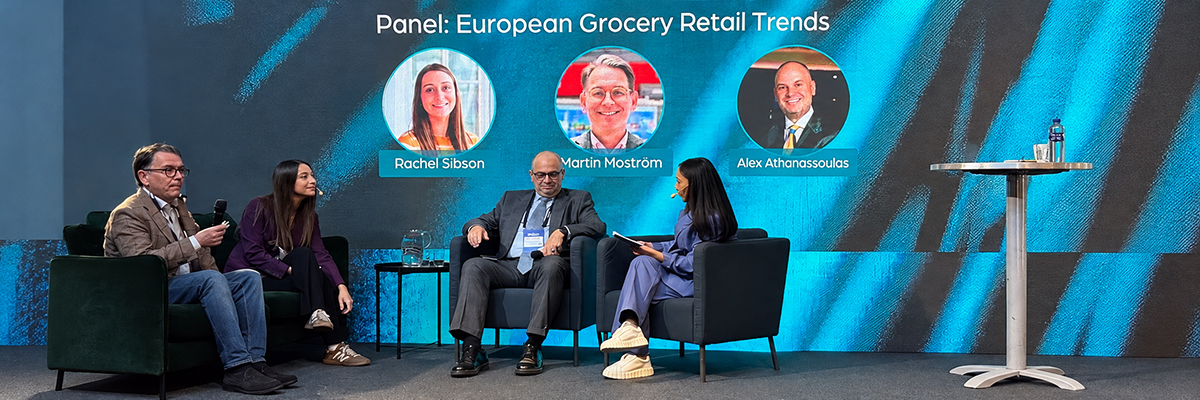
Alex Athanassoulas joined Rachel Sibson, Senior Insight Analyst at IGD, and Martin Moström, CEO, Strategic Advisor & Founder, for the European Grocery Retail Trends panel at the Nordic Grocery Store Expo 2026 in Stockholm.
Alex Athanassoulas is the President & CEO of STIRIXIS Group. In October 2026, he delivered the keynote “Retail in the Perfect Storm” at the Nordic Grocery Store Expo in Stockholm. STIRIXIS Group works across Strategy, Design, Execution and Evolution to create long-term value and True Prosperity.
As Featured In
— Fri Köpenskap
The expert: The store is facing its biggest shift in 110 years
Coverage of Alex Athanassoulas’s keynote “Retail in the Perfect Storm” at the Nordic Grocery Store Expo 2026. Read the article →
Explore STIRIXIS Retail →
stirixisgroup.com | advance@stirixis.com
Follow Alex Athanassoulas on LinkedIn