

Why experience must inform business strategy and investment decisions.
By Elena Kyrnassiou-Athanassoula | Vice President & Executive Director, STIRIXIS Group
SUMMARY
Physical environments are increasingly judged by the experiences they enable—not just their location, capacity or appearance. From hospitality to travel destinations, changing expectations challenge investors and operators to bring human behaviour into the business brief. Elena Kyrnassiou-Athanassoula examines how spatial quality, foresight and strategic asset repositioning can influence preference, commercial opportunity and lasting value.
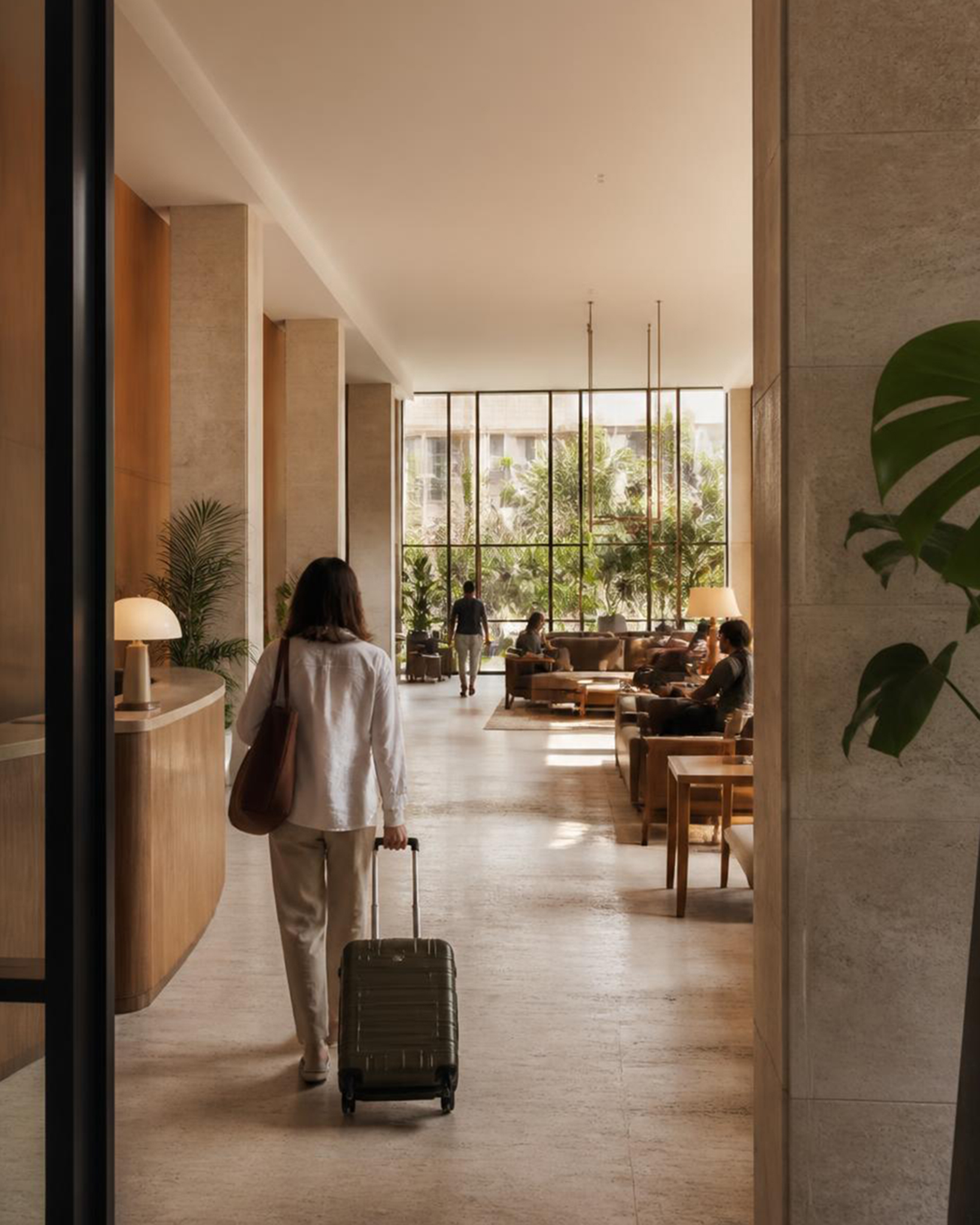
A guest books a room, a passenger passes through an airport, a visitor enters a destination. Businesses often measure these moments as separate transactions. People experience them differently: as parts of a continuous journey that can feel intuitive, frustrating, memorable or forgettable.
That distinction is becoming a strategic consideration. The performance of a physical environment depends not only on its location, capacity or appearance, but also on what people are able—and motivated—to do within it.
From Transactions to Decisions
Travel offers a revealing example. Digital services can shape a traveller’s choices long before arrival; expectations of convenience, relevance and flexibility continue once they enter a terminal, hotel or neighbourhood. The physical environment must therefore do more than accommodate demand. It should respond to the behaviours driving it. This changes the questions asked of developers and operators: where does the journey begin, when does attention turn into engagement, and which spatial decisions make the experience easier to navigate and more rewarding to use?
An airport retail offer disconnected from passenger movement may miss opportunities. A hotel whose shared areas remain underused may have invested in facilities without defining their role in the guest experience. A destination with strong visitor numbers may still struggle to translate footfall into meaningful local economic activity. None of these challenges is resolved by aesthetics or technology alone.
Experience Belongs in the Business Brief
Experience is too often treated as a finishing layer: atmosphere after layout, digital features after construction, branding after the business model. It should enter the conversation much earlier. Who will use this space? What will they need at different moments? Which interactions create convenience, connection, discovery or additional commercial opportunity? Those answers should influence the investment brief, from the mix of functions and the allocation of space to circulation, service touchpoints and opportunities for future adaptation.
The quality of a space also influences these outcomes in less obvious ways. Light, materiality, proportion, orientation and the balance between privacy and sociability shape whether people feel comfortable, confident and willing to stay. Such choices are human in their effects and commercial in their implications. They can support preference and perceived value, although they do not guarantee revenue.
The experience is not what happens after the business decision. It is part of the business decision.
A Building is not yet a Proposition
Consider a former office building in central Athens being transformed into a contemporary hospitality concept. Accommodation is only one part of the proposed experience. Shared spaces, rooftop dining and the relationship with the surrounding neighbourhood create reasons to gather, explore and spend time there. The opportunity lies in repositioning an existing asset around a coherent visitor proposition—not simply changing its use. The project remains in development; its performance is not yet established.
From Foresight to Value Creation
Tomorrow’s expectations will not stand still. METALLAXIS strategic foresight can help challenge assumptions about changing behaviours before capital is committed. For STIRIXIS Group, the response begins with identifying a suitable real estate opportunity where relevant, defining its commercial potential and connecting Strategy, Design, Execution and Evolution through the Value Creation Circle™. It clarifies where to invest first and how to measure outcomes.
The question for investors and operators is no longer only what space to build, but what experience the business needs to make possible.
Explore what your next space could achieve.
Discuss your hospitality or destination opportunity with STIRIXIS Group: advance@stirixis.com